Extra bonus points for folks who can name that movie!
It’s been a hot minute since we’ve updated the blog since most of the progress has been minor- mostly due to a combination of holidays, sourcing the last few bits and pieces (takes longer when you’re going for reuse), and a sprained ankle. The ankle is healing nicely and we had a good run at reuse stores a couple weekends ago, though, so progress is moving along again!
We’ve gotten a lot of questions about how Dandelion’s going to power all the things. Up until now, we’ve been hooking up to shore power, which we had installed before delivery. At it’s easiest, we have a shore power to standard plug adapter that gets plugged into an extension cord to the house. There’s also a standard RV shore power plug to hook up at campsites where it’s available. While that’s all well and good, we’ve never been much for planning adventures overly much, so there’s an excellent chance we’ll be in a lot of places without power hookups in the future. What then?


Why not a big-ass battery bank and solar panel set up?
This consists of a 5 kilowatt solar system (or solar generator) with:
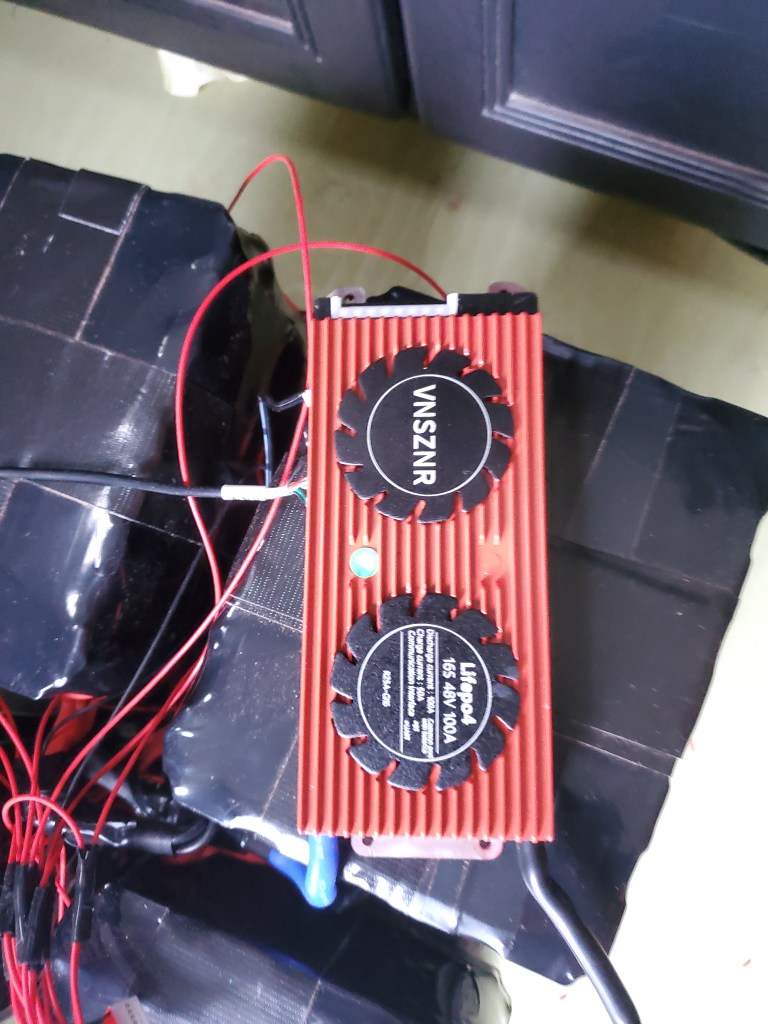
- 5 kilowatt-hour 51.2 volt LiFePO4 battery, which is self built from 16 100-amp hour LiFePO4 modules hooked up in series,
- A 100-amp battery management system (BMS),
- 1.25 kilowatt solar panel array, 4 panels in total (for now),
- Inverter/Charge Controller, which has both shore and/or solar power, to provide 5 kilowatts of pure sine wave 120 volts AC power for charging batteries and powering stuff, appliances, lights, etc. in Dandelion.
- This acts as an automatic uninterruptable power supply (UPS) which switches seamlessly between shore, solar, and battery power without any interruption in electricity. Power goes from this controller into the breaker box, then to a couple different runs.
When fully charged, the battery bank can provide power for essentials for several days before needing recharged. In ideal conditions, the solar panel array should be able to fully recharge the battery from empty in about 5 hours.
We get a LOT of rain out here, and while our initial tests indicated that the solar panels perform admirably in overcast conditions, we also REALLY like to be extra-prepared. For extreme circumstances, there is also a 3,500 watt continuous pure sine wave inverter generator. For those of you who aren’t electrical-tech savvy, it’s a gas powered generator that can provide shore power. This is, of course, the super-backup option and we plan to use solar and battery as much as possible.
The beauty of this whole set up means that for short weekend getaways, we should be able to charge up the battery before leaving the house and have enough power to last the entire weekend. For longer trips, we have multiple options for power which gives us a lot of flexibility in where we go and what we do.
Why did you choose DIY instead of an entirely prebuilt solar array and battery system?
- Cost- piecing out and connecting everything ourselves, this system cost less than 50% of what a professionally installed commercial system would.
- Quality- piecing out the system meant that we were able to identify the components with the best warranty, quality rating, and/or longevity.
- Customization- this setup will let us add in, take out, or modify components if needed which gives a lot of flexibility for future uses.
- Existing Skills- both of us are qualified for and have experience with maintenance of electrical (and battery) systems, and one of us has extensive skills in electrical theory and building battery systems.
We happen to be fully qualified to perform all the work detailed in this post and in the blog- if you plan to do something similar, you need to be fully qualified OR hire a qualified professional! Electrical systems are nothing to play around with- if improperly handled, electricity is fatal.
 Dandelion On The Whim